BRONZE SQUADRON COMBAT LIFESAVER HANDBOOK
1. CLS
The Combat Lifesaver, or CLS, is a soldier who is trained to provide immediate care that can save a casualty's life in the field of battle. Combat Lifesavers will often be the first line of response in treating and stabilizing injured soldiers, and will work with and under the supervision of the Combat Medical Personnel assigned to their elements. The primary role of the CLS is to secure the casualty and transport them to a safe place to provide care, manage any bleeding that may have resulted from the casualty's wounds, and to monitor the casualty's vitals until medical personnel can take over. CLS will also receive training in the utilization of advanced care to help treat and revive any medical personnel who should become incapacitated if no other support is available.
Medical Equipment
| Equipment | Function |
|---|---|
| Tourniquets | Slows severe bleeding in limbs. Casualty continues to bleed but at a much-diminished rate. Tourniquets are 60% faster to apply than bandages which makes them useful when attempting to treat multiple bleeds rapidly or when conducting care under fire. |
| Bandages | Stops bleeding completely and are generally the first and most frequently used method of care. |
| Saline | Replaces lost blood volume. Two sizes available: 750ml and 1500 ml. 750ml provides a 33% increase to blood level and should be applied to any casualty with a class I or II Hemorrhage, 1500ml provides a 66% increase to blood level and is used on Class III and IV hemorrhages. |
| King LT | Opens and maintains airway for casualties in the Supine position. |
| Oxygen Mask | Increases the breathing rate and SpO2 of a casualty. |
Vitals
Heart Rate (HR), Blood Pressure (BP), Hemorrhage Class, and Peripheral Oxygen Saturation (SpO2) all combine to make up what are known as vitals. These are the values used to determine your casualty's current medical status. A casualty for whom any of their vitals have fallen into a critical state will fall unconscious. If their vitals continue to drop, they may go into what is known as cardiac arrest, or a discontinuation of heart function and respiration. Once in cardiac arrest, the casualty will have approximately 17 minutes before irreparable damage to the brain occurs due to lack of blood and oxygen and the casualty will expire. Note: Generally, HR and BP scale together and our current medications effect both simultaneously. This means that BP can often be a redundant measurement and most of the medics attention can go toward HR. With that being said, it is important to be aware of BP in the instance where it may need to be medically managed within the casualty's stable HR range.
2. COMBAT LOADOUTS
Whenever possible, medical equipment and medications should be stored in the CLS's backpack. This is for two main reasons: Firstly, so that you can at a glance get an accurate count of your current inventory and any potential shortages, and secondly so that both you and any other medical personnel know where your items are stored and can access them quickly. Your CLS bag should contain:
- 10x Bandages
- 5x Tourniquets
- 2x 750ml Saline
- 2x Ammonium Carbonate
- 2x NCDs
- 2x Chest Seals
3. MEDICAL INTERACTIONS
It is important to be familiar with casualty anatomy as well as which treatments and medications can be applied to each of the particular body parts. When looking at a casualty, you can hold ALT to conduct a quick scan of the casualty, and any bleeds will be highlighted either in yellow or red depending upon the severity. Items in italics will only appear if casualty is in need of treatment.
Chest
- Check Pulse
- Perform CPR
- Bandage (If equipped and needed)
- Use Chest Seal (If equipped and casualty has Open Pneumothorax)
- Perform Needle Decompression (If equipped and casualty has Tension Pneumothorax)
Abdomen
- Check Injuries
- Drag
- Carry
- Load Casualty in vehicle (ambulance only)
- Put on Back
- Put in Left Recovery
- Put in Right Recovery
- Bandage (If equipped and needed)
Head
- Check Pulse
- Check Respiratory Rate
- Lift Chin
- Bandage (If equipped and needed)
- Clear Vomit (If necessary)
- Hold Under Nose (If Ammonium Carbonate equipped)
Arms
- Check Pulse
- Check Blood Pressure
- Check SpO2
- Apply Saline (If equipped and needed) (Can be applied to either arm but will always be placed on casualties Right Arm)
- Bandage (If equipped and needed)
- Apply Tourniquet (If equipped and needed)
Legs
- Check Pulse
- Check Blood Pressure
- Bandage (If equipped and needed)
- Apply Tourniquet (If equipped and needed)
Equipment Recovery Note
Many interactions will expend 1 item. However, some items such as Tourniquets, Oxygen Masks, and King LTs can be recovered and reused once no longer needed. When treating multiple injuries, you will have to re-equip the item after utilizing (i.e. when bandaging both arms, you will have to re-equip a second bandage after the one in your hand is used).
2. CARDIOPULMONARY RESUSCITATION (CPR)
CPR is an emergency procedure utilizing chest compressions to maintain blood flow and oxygenation when a casualty is in cardiac arrest. CPR, in conjunction with the administration of Epinephrin, is necessary in order to prevent the casualty from going to KIA and to extend the amount of time available to provide care. CPR can now be provided continuously without the need to switch out providers. When conducting CPR as the only medical personnel on site, it is best to do so in stretches of 30 compressions, stopping to check both the casualties pulse and verify their airway is still clear. If working in a pair, CPR can be conducted by one individual while the second monitors vitals and administers and medications.
NOTE: If checking pulse while CPR is being conducted you will receive a reading even though the casualties heart is still not beating on its own. BPM must be ABOVE 120 in order to discontinue CPR. Epinephrin should be utilized jointly with CPR when attempting to resume normal heartbeat and can be applied once every minute, or after every second set of 30 chest compressions.
3. TACTICAL COMBAT CASUALTY CARE (TCCC)
While providing proper medical treatment to a casualty can be a daunting task on its own, Combat Lifesavers must also deal with the stressors of doing so under fire and simultaneously managing the tactical situation as well. A medical intervention at the wrong time or improper implementation of medications may lead to further casualties. Put another way, "Good medicine may be a bad tactical decision." It is important to have a grasp not only on the care of the casualty you are treating, but also on the situation in which you are treating them to prevent one casualty turning into many. TCCC can generally be broken down into two distinct phases: Care Under Fire and Tactical Combat Care.
Care Under Fire
Care rendered at the scene while both the CLS and casualty are still taking effective hostile fire, and the risk of additional injuries at any moment due to hostile fire is extremely high.
During this phase, the first step in providing care for the casualty is to gain awareness of the tactical situation. No care should be provided if the casualty is still under heavy enemy fire.
Use the principles of START to move the casualty to a safe position. If there is still a high probability that you may be injured in attempting to retrieve the casualty, instruct others around you to do so. You have a very specialized skillset and the tools needed to provide care for any casualties that occur. If another casualty occurs attempting to retrieve the first you have the training to treat both, if you are injured attempting to reach the casualty it diminishes the likelihood of either of you receiving the necessary care.
Casualties who are able to move under their own power to cover should be instructed to do so in order to expose other caregivers to unnecessary hazards and risking the lives of others.
Additionally, casualties who have sustained non-life-threatening conditions and have the ability to remain in the fight should do so and help provide security for you both as you render aid.
Lastly, it may be the case in certain situations that you are required to delay care in order to secure the environment prior to rendering aid. If momentarily continuing the fight will allow you to secure an area to move yourself and your casualty to cover then it is often the prudent course of action.
Tactical Combat Care
Care rendered once the CLS and casualties are no longer taking effective hostile fire and have moved to a relatively secure location.
Medical care during this phase is directed toward more in-depth evaluation and treatment. It is at this time when you are no longer under imminent threat that you can conduct a full evaluation, bandage any bleeds which may have just been tourniqueted during care under fire, and assess for less immediate wounds such as pneumothorax or blood loss.
Casualties are not to be discharged until cleared by medical personnel. This ensures the casualty is stable, does not require any further treatment, and provides medics and opportunity to recover any equipment the casualty no longer requires.
4. PROPER RECOVERY OF CASUALTIES (START)
When retrieving a casualty, safety throughout the process should be of utmost priority. Rushing in blindly is the quickest way to turn a single casualty into a MASCAS event and loss of medical personnel. The following steps should be utilized to ensure the casualty is recovered with the least amount of additional injuries to yourself and others in the process.
Secure
When casualty occurs, confirm that you are not currently also in the line of fire and find a secure place to assess the current situation.
Threat
Identify what has caused the casualty. For distant threats, tracers and bullet impacts are typically your best bet, closer threats may provide audible clues as well.
Action
Suppress or eliminate the threat if possible, otherwise utilize smoke to obscure the enemy's line of sight by providing concealment between the casualty and what caused the injuries.
Recover
When safe to do so, move the casualty to a safe location, ideally somewhere inside that has already been cleared. Sometimes this may mean that as part of the Action phase you must bypass the casualty to assist in clearing a nearby building, then returning when you know you have a safe place to treat.
Treat
Once casualty has been moved to a safe location, begin administering medical aid.
2. CASUALTY COLLECTION POINTS (CCP)
If the situation arises where there are multiple casualties requiring care, a CCP can be established in a safe area away from enemy fire. The CCP will provide a location to conduct triage and treatment to the wounded, while also establishing a singular point for leadership to provide security and direct any additional wounded be taken to for care. The CCP can also provide a known location for assistance to move to in order to help aid.
Depending upon the tactical situation and the amount of available support, the medics role may redirect from a primary caregiver to triage and supervisor in order to coordinate resources and ensure the optimal care is being provided. Whenever possible, direct others to take on such tasks as bandaging and CPR, leaving yourself available to provide direction and more complex treatments to multiple casualties simultaneously.
When coordinating care, be sure to prioritize those individuals that can have the greatest impact one returned to the fight. Prioritization of care should go as follows:
- Medical Personnel so they can assist with other wounded
- Leadership to coordinate with other units to provide assistance if needed
- Critical weapons systems AT if armor is nearby, MG for volume of fire, JTAC if air is needed, etc.
- Any remaining wounded
3. MULTIPLE CASUALTY INCIDENT (MCI) AND MASCAS
As mentioned earlier, a Multiple Casualty Incident (MCI) is any sudden influx of casualties, typically 3 or more or 33% of the element, which will severely impact the element's ability to continue with their tasking until treatment can be provided. The medic on site will call up that they have an MCI and how many casualties are involved, then proceed with setting up a CCP and enlisting the aid of any available nearby units in providing care.
If a MCI develops to the point at which it exceeds the medic's ability to provide proper treatment for all wounded with the resources on site, a MASCAS is declared. The medic will call on the medical net "MASCAS, MASCAS, MASCAS," and provide their current location over the radio, as well as deploy purple smoke to assist others in locating the position quickly. This call will notify all nearby elements that your unit has sustained severe casualties and all available support will be directed to your location to help provide care.
Be advised: all units will make best speed to come and provide aid which will diminish the ability for other elements to remain on task, and if you are still under heavy fire could result in additional casualties. We are all one team out there and sometimes that means taking risks to best assist one another. With that being said, if you are not the individual at the MASCAS, you do still have a responsibility to your current tasking as well. Communicate with your team leader about the situation and try to coordinate the most effective method of response. There may be times where it is more important to stay with your team and your team leader will make that decision. DO NOT just leave your swim buddy.
4. VEHICLE CASUALTY CARE
In its current state, we are not about to treat any casualty when we are seated in a vehicle beyond bandaging any bleeds they may have. The one exception is on the CH-47 where we can provide all available treatments when we are standing, but if the casualty goes into cardiac arrest while seated we cannot administer CPR. We also cannot move a casualty from a seated position to the floor, so if they go into cardiac arrest while seated we either have to unload them from the helicopter or delay treatment.
With this being the case, should we take casualties when preparing to board the helicopter, if the casualty is already unconscious they should be carried on and laid on the floor. If the casualty is conscious when the helicopter lands and is at risk of passing out, then they should be directed to walk on and lay down on the floor instead of occupying one of the seats until they can be stabilized.
5. MARCH
The MARCH medical protocol is a TCCC mnemonic designed for treating critically injured patients by prioritizing the most likely preventable causes of death:
- Massive Hemorrhage
- Airway
- Respiration (or Breathing)
- Circulation
- Hypothermia/Head Trauma (not modeled)
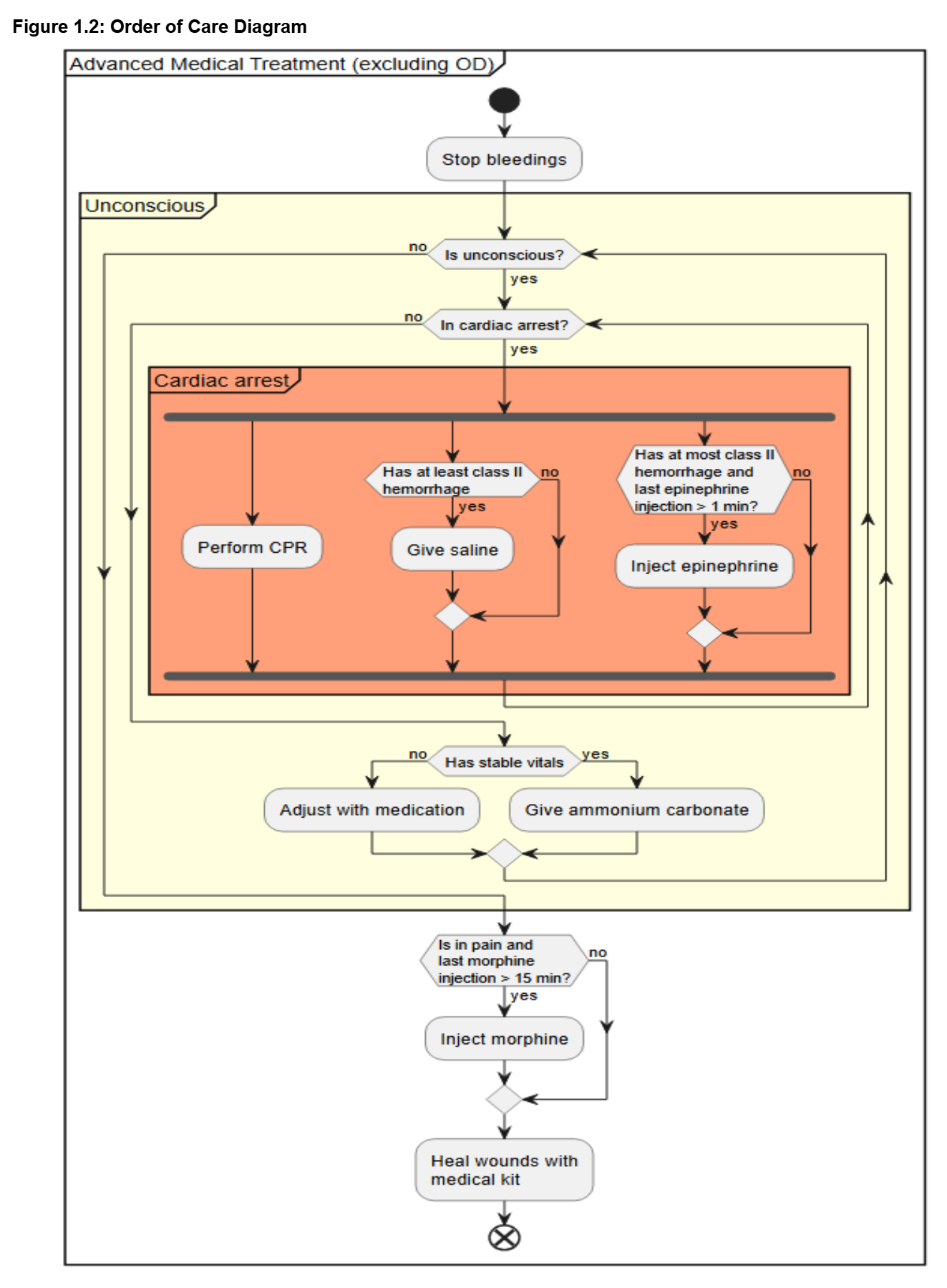
1. ADMINISTRATION OF MEDICAL AID
Proper Recovery of Casualties
Secure casualty and find safe location to treat
Check Injuries
Assess the following conditions:
- Bleeding Level (Heavy, Moderate, Light)
- Hemorrhage Class (Class I, II, III, IV)
- Pneumothorax (Open vs Tension)
Massive Hemorrhage
- If limbs are bleeding, use tourniquets to decrease bleed rate
- Once tourniquets are applied, stop bleeding on abdomen, chest, and head if applicable
- If right arm is bleeding, bandage arm and remove tourniquets, then apply saline bag to prevent bleed out
- Stop any remaining bleeding by applying bandage
Airway
- If casualty has a Tension Pneumothorax, administer an NCD kit (Note: will result in Open Pneumothorax)
- If casualty has an Open Pneumothorax, apply chest seal
- If casualty has an occluded airway, clear vomit, then lift chin
Circulation
- Remove tourniquets if applied
- Check casualty pulse
- If no pulse, begin CPR
- If pulse is present, monitor trending patterns in vitals (i.e., increasing vs decreasing)
If treating casualty alone:
- Conduct 30 chest compressions, check for airway occlusion, check hemorrhage class/saline applied, check for pulse, and repeat if necessary
If treating casualty with aid:
-
One can conduct compressions while the other checks pulse, airway occlusion, hemorrhage class/saline applied
-
Note: pulse must rise above 120 to be stable due to false reading from compressions
-
If casualty still has no pulse after one minute, continue CPR cycle
Health
- If casualty has pulse, is stable, and saline is being administered, place in Left Recover to prevent occlusion
- Once blood level reaches Class 1 hemorrhage or less, resuscitate casualty by administering Ammonium Carbonite
- Once casualty is conscious, conduct a final scan to ensure that they are indeed stable and do not require any further treatment
- This is also when the medic will recover any equipment no longer required to treat casualty injuries (i.e. oxygen mask, King LT, etc.)
- Casualty is not to be discharged until fully cleared by attending SOCM, SARC, or PJ
KIA Protocol and Identification
Should one of your soldiers fall in the field, send that information up your team net so that leadership is aware that the element is down one soldier and can adjust accordingly. Once the communication has been sent up, contact the supervising SOCM to determine whether they want you to pull the soldier's identifying paperwork, or if they will retrieve the document themselves. Documents shall be provided to your SOCM at the earliest practical time for record keeping purposes.
Figure 1.2: Order of Care Diagram